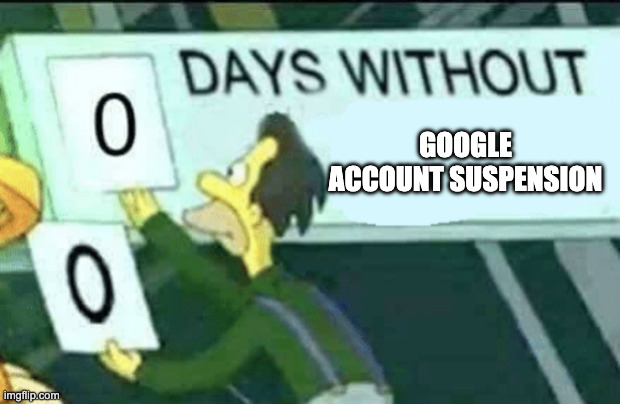
For many people a Google account is the central access point for their digital identity. For a great many people, in fact. Through SSO, we gain access to many platforms and systems. Communication often runs entirely through Gmail. That starts with forum logins, continues through GitHub accounts, and can extend all the way to tax returns or communication with your health insurer. It may even lock you out of your phone, that you use to pay or log in to your banking account. Google Mail is way more than communciation. It’s access and identity. The digital sphere has completely absorbed real life. More for some, less for others.
That is reason enough to keep advocating for digital sovereignty. But that is not the point here. I want to raise a different question and illustrate the problem with a current report: Google has suspended the account of a Japanese manga artist [ reddit.com ]. This is not the first time and it does not only concern Google. Microsoft is also known for deleting or suspending accounts for different reasons:
- ‘Microsoft killed my online life,’ Microsoft is reportedly banning Palestinians in the U.S. for life for calling relatives in Gaza
- Need help, locked out of Google account with 10 years of personal data
- Microsoft Account Suspension Leads to Loss of 30 Years of Personal and Professional Data
- Account Terminated without Warning: Victim of Scam - Seeking a Second Chance after 1.5 Years
At first, that sounds trivial. A few emails are missing, probably some images, that is all? Where’s your BaCkUp?
Well… as I described at the beginning, the simple email account, whether from Google or another provider, has evolved from a purely digital communication medium into a central link to real-world identity. It is not just about emails, but about the representation of one’s own personality in digital space.
That gives providers like Google a special responsibility that goes far beyond the customer-company relationship.
Even if Google acts primarily, and understandably, according to economic interests, its influence on an essential basic service is enormous. When it comes to access to the internet, policymakers have imposed important rules on providers, going so far as to recognize that access as a basic right. Yet major identity platforms like Google remain largely unregulated when it comes to responsibility in the context of public provision. As a private company, Google can decide on its own, and relatively opaquely, when an account is deleted. There is no neutral appeals process or even an “in dubio pro reo” rule.
That is a problem. The call for digital sovereignty is not the right step here either, because it shifts responsibility onto consumers. Just ask your parents, who are in their mid-60s, why they not host their own email and LDAP server. We should not overlook the fact that not everyone is readily able to implement sovereign alternatives.
That is why politics is needed: to better oversee the rules for account management by large companies, so that decision-making power is placed in the hands of a neutral party.